Bathroom Remodeling · Lino Lakes, MN
Tub-to-Shower Conversion in Lino Lakes, MN
The most common Lino Lakes bathroom upgrade. Free estimate on inserts, custom tile, and curbless conversions.
- Inserts, tile, and curbless options
- Waterproofing done right
- Free written scope
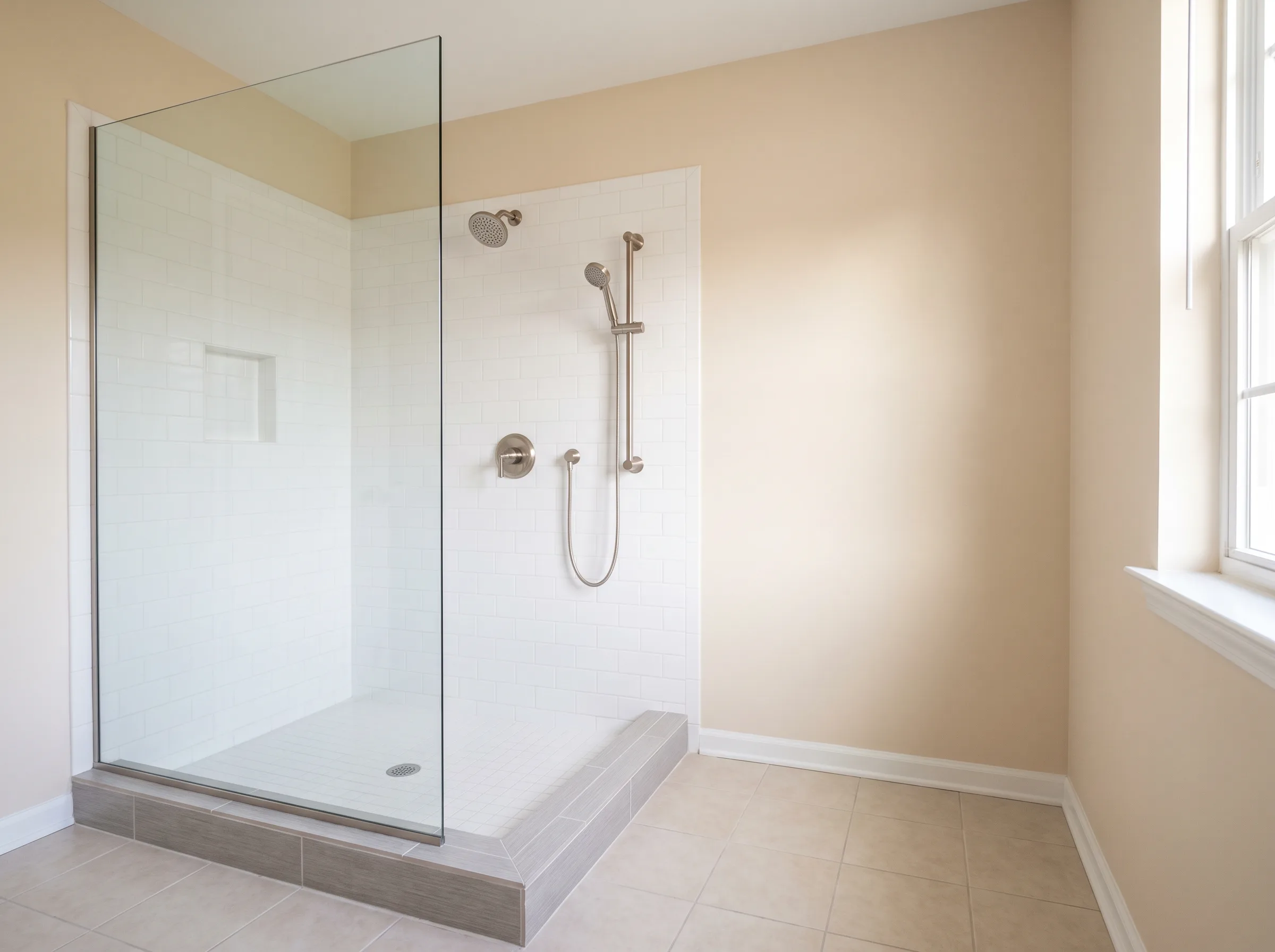
A tub-to-shower conversion in Lino Lakes typically costs $3,000 to $10,000 (Minneapolis Kitchen & Bath, Google AI Overview). Insert swaps in the Minneapolis market start near $1,800–$4,430 (Modernize), while full wet-area conversions are quoted at $8,000–$15,000 (Home Depot). Most take one to two weeks.
When does a tub-to-shower conversion make sense?
Four situations account for nearly every conversion in this city.
The tub is never used. A 1990s hall bath with a builder-grade fiberglass tub-shower unit is the single most common bathroom configuration in Lino Lakes, where a large share of housing was built between 1970 and 1999 (NeighborhoodScout). If nobody in the house has taken a bath in five years, the tub is just a 60-inch obstacle you step over twice a day.
Aging in place. Stepping over a tub wall is the highest-risk movement in the room. Accessibility planning is now mainstream: 68% of homeowners consider special needs when planning a bathroom project (2025 U.S. Houzz Bathroom Trends Study), and 73% of industry leaders report increased aging-in-place requests over five years (NAHB). With 11.1% of residents 65 or older (Wikipedia), that is a live conversation in a lot of Lino Lakes households — see accessible bathroom remodeling.
The surround is failing. Cracked pan, spongy floor at the apron, discolored grout lines, a musty smell. Water that gets behind a surround does not stay there — it moves into subfloor and framing, which turns a $6,000 conversion into a much larger repair.
One-bathroom households and small footprints. In a compact three-quarter or hall bath, deleting the tub buys usable floor area and makes the room feel a size larger without moving a wall. That interacts closely with the strategies on the small bathroom remodel page.
What’s involved in converting a tub to a shower?
The sequence below reflects the standard steps for a conversion, which most crews complete in about 10 to 14 days (Google AI Overview):
- Layout and drain planning. Shower size, door swing or panel position, and whether the drain stays put or moves. Keeping the drain where it is saves both money and permit scope.
- Protection and demolition. Floor protection, dust barrier, then the tub and surround come out — often cut in place, since a 60-inch tub rarely clears a 30-inch door.
- Inspection of what’s behind it. Framing, bottom plate and subfloor evaluated. Damage found here is why the estimate carries a contingency.
- Framing adjustments. Curb built or recessed floor prepared, blocking added for a bench, grab bars or a niche.
- Plumbing adjustment. Valve raised to shower height, drain adapted, supply reworked. This is the step that requires a plumbing permit from the Lino Lakes Building Department (City of Lino Lakes).
- Waterproofing. Pan assembly and wet-wall membrane installed as a continuous system, sloped to drain.
- Base or tile. Either an acrylic base and wall panels, or a mud bed and tile.
- Valve trim, glass and finish. Trim kit, glass panel or door, caulking, paint, ventilation check.
Insert vs. custom tile: which should you choose?
| Factor | Acrylic or fiberglass insert | Custom tiled shower |
|---|---|---|
| Typical installed cost | About $1,800–$4,430 in the Minneapolis market (Modernize); prefab walk-in showers overall $1,000–$8,000 (HomeGuide) | About $3,500–$15,000 (HomeGuide); wet-area conversions $8,000–$15,000 (Home Depot) |
| Time on site | Shortest — often a few days once the tub is out | Longer — pan, membrane, setting and grout cure add days |
| Size flexibility | Limited to manufactured sizes; must fit the existing alcove | Any dimension, including odd 1990s alcoves and angled walls |
| Maintenance | Fewer grout joints; wipe-clean surface | Grout and caulk need periodic attention |
| Design range | Limited colors and textures | Full range of tile, niche, bench, patterned floor |
| Resale impression | Reads as practical and clean | Reads as an upgraded bathroom |
| Best for | Hall and guest baths, budget-driven scopes, rental-quality durability | Primary baths, curbless designs, non-standard footprints |
Neither is the “right” answer. The insert is the honest choice for most Lino Lakes hall baths; tile earns its premium when the shower is one you use every day or the footprint is nonstandard. Full walk-in options are compared on the walk-in shower installation page.
One middle path deserves more attention than it gets: a factory-molded base paired with tiled walls. The base arrives with engineered slope and a sealed drain connection — the two details most likely to fail when built by hand in the field — while the walls get real tile at eye level, where the room is actually judged. In a standard 60-inch alcove that combination usually prices between the insert and the full custom build, installs faster than a mud-bed pan, and leaves fewer horizontal grout joints to maintain. For a hall bath used by kids and guests, it is frequently the best value decision in the whole project.
Curbless or curbed?
| Factor | Curbed walk-in shower | Curbless / zero-threshold |
|---|---|---|
| Added cost | Baseline | Roughly $500–$700 more than a comparable curbed shower (Angi); $5,000–$12,000 for most mid-range builds (Minneapolis Kitchen & Bath) |
| Floor work | Curb built on existing subfloor | Subfloor recessed or the room floor built up for slope |
| Drain | Center point drain typical | Linear drain common, about $500–$1,200 (Angi) |
| Accessibility | Still requires a small step over | Nothing to step over; walker and wheelchair friendly |
| Water containment | Curb contains water mechanically | Depends entirely on correct slope and glass placement |
| Best for | Standard hall baths, tight budgets, upper floors with limited joist access | Aging-in-place plans, slab or accessible joist bays, wet-room designs |
Do you need a permit for a tub-to-shower conversion in Lino Lakes?
Yes, if anything behind the wall changes. Moving, adding or altering water supply lines, drain lines or vents requires a plumbing permit from the Lino Lakes Building Department, which publishes a separate plumbing permit application; adding an exhaust fan that vents to the exterior is mechanical-permit work; and electrical permits come from the State of Minnesota rather than the city (City of Lino Lakes). Contractors must register with the city before they can apply online (Building & Inspections). A pure like-for-like fixture swap with no line changes is usually the only version that escapes a permit — the full rundown is on the permits page.
Cost breakdown for a Lino Lakes conversion
- Insert conversion, drain stays put: roughly $1,800–$4,430 in this market (Modernize).
- Mid-range conversion with new base, tile walls and glass: the $3,000–$10,000 core band (Minneapolis Kitchen & Bath).
- Full custom tiled wet area with relocated drain: $8,000–$15,000 (Home Depot), and past $15,000 when glass and tile selections climb.
- Curbless upgrade: add about $500–$700, plus $500–$1,200 for a linear drain (Angi).
- Related scope: if the vanity, floor and toilet are also tired, compare against a full remodel at $13,000–$25,000 on the cost page — combining the work is usually cheaper than doing it twice, and the full bathroom remodel page explains why.
For reference at the low end, a straightforward tub replacement in the Minneapolis market starts around $1,200–$2,800, with standard projects at $2,900–$4,500 (Rosemount Bathrooms) — useful if you are weighing “replace the tub” against “delete the tub.”
What should you ask when getting conversion quotes?
- Is the drain moving, and does that trigger a plumbing permit?
- What waterproofing system is being used on the pan and wet walls, and will it be inspected before tile?
- Is blocking for future grab bars included? It costs almost nothing while the wall is open.
- Is the exhaust fan ducted to the exterior, and is it being upgraded?
- Is glass included, and is it measured after the base is set or ordered in advance?
- Who is responsible if rot is found — and what is the unit price for subfloor repair?
- Is the contractor licensed in Minnesota, and does the license check out in the state lookup? Minnesota requires licensure for anyone contracting directly with a homeowner using more than one special skill (Minnesota DLI).
Conversion FAQs
How much does it cost here? $3,000–$10,000 typical; inserts from about $1,800; full wet-area builds $8,000–$15,000 (Minneapolis Kitchen & Bath, Modernize, Home Depot).
How long does it take? About 10 to 14 days for most conversions (Google AI Overview).
Is a permit needed? Yes for any plumbing line change (City of Lino Lakes).
Will it hurt resale? Rarely, if the house keeps one tub — and most Lino Lakes homes have multiple baths (NeighborhoodScout).
What does curbless add? About $500–$700, plus the linear drain (Angi).
Get a conversion quote for your bathroom
Conversion pricing hinges on two questions a photo can answer: how big is the alcove, and does the drain need to move? Send the alcove dimensions and a picture of the existing tub wall through the estimate form and a licensed Minnesota contractor will come back with a written scope for both the insert and the tiled version, so you can compare them side by side. Start on the homepage if you want the full service overview first.
Ready to price your Lino Lakes bathroom remodel?
Get a free written estimate — typically returned within one business day. No cost, no obligation.
Get My Free Estimate